
Potty learning can feel tough, especially when things aren’t going smoothly, but every child has their own timing. Some days will be messy, but that doesn’t mean anything’s wrong. Your child is learning something completely new, and you’re right there with them. Accidents don’t mean failure—they’re part of the process. With a little patience, trust, and kindness, you’ll get through this together.
Every Child Learns at Their Own Pace
It might feel like potty learning is taking forever, but it’s okay. Some children learn in days, while the potty training duration for some kids can span months. If your child is having a hard time, it doesn’t mean you’re doing something wrong. And it definitely doesn’t mean your child is behind.
What Helps:
- Notice the signs: If your child doesn’t seem ready, take a breath and give it more time. Not every child, boy or girl will show signs in the same way—and that’s okay. If you’re unsure what to look for, use a readiness guide to help spot when your child might be ready to try.
- Stay calm during accidents: Accidents are going to happen. Try a calm, neutral tone like, “Your body is still learning! Next time, we’ll try the potty again.”
- Make it part of your day: Add potty time into your daily rhythm—before naps, after meals, before leaving the house—so it feels easy and expected. Focus on the day before even thinking about nighttime.
What If They Don’t Say They Need to Go?
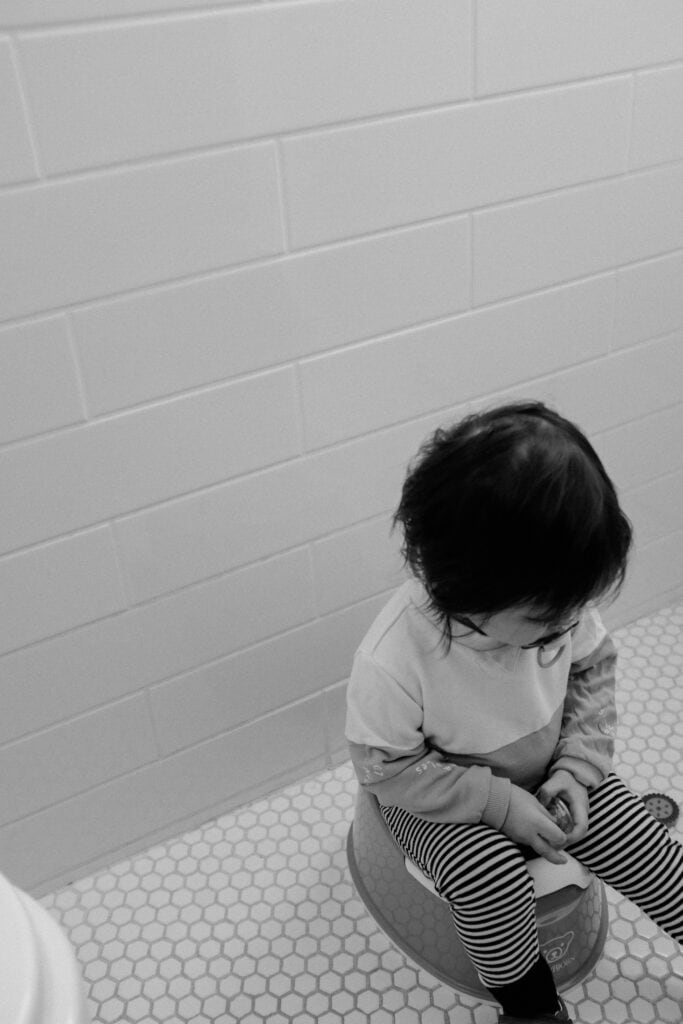
Worried your child doesn’t warn you before going? That’s very common at the beginning. Most kids don’t tell you—they just go. It’s not a setback; it’s just where they are.
Tips to Try:
- Talk about body sensations: Help them notice how it feels inside. You can say, “When you feel your tummy pushing a little, it might be time to use the potty.”
- Stay nearby: When they’re without a diaper, watch their body language. Some kids freeze, squirm, or grab between their legs.
- Make it playful: Use games, songs, or bubbles to help them relax and get used to sitting on the potty.
Working Through Common Challenges
There might be moments your child says no to the potty or has trouble holding it. That doesn’t mean they’re not capable—it just means we need to adjust the approach.
Not sure whether to start with a potty or seat reducer? A simple guide can help you choose what fits your child best.
What You Can Do:
- Refusing the potty? Offer small choices to give them a sense of control: “Do you want to bring your book or your toy dino to the potty?”
- Can’t hold it? Try offering more potty breaks during calm times to reduce pressure and catch those moments before it’s too late.
Potty Learning by Age: What to Expect
Each age comes with its own little quirks. If your 3-year-old is resisting, it might be because they’re discovering independence, or just not a fan of big changes.
What Helps:
- Use encouraging words: “Your body is learning something new, and you’re doing such a great job.”
- Match their personality: A sensitive child might need calm, quiet encouragement and privacy. A more flexible child might enjoy silly routines, using toys and clear goals.
When They Say “No!” to the Potty
Some kids flat-out refuse—and that’s okay too. Refusal usually means your child is feeling unsure, overwhelmed, or just not quite ready.
Especially around age 2, you might be seeing more tantrums, big feelings, and resistance—it’s all part of that emotional growth phase.
Gentle Responses:
- Pause if needed: You can always stop and try again later when things feel easier for both of you.
- Keep it light: Read a potty-themed book together or sing a potty song. Keep it playful and low pressure.
- Validate their feelings: “It feels a little scary, huh? I get it. I’m right here to help.”
Potty Learning at Age Three: Taking the Long Road
If your child is 3 and things aren’t clicking yet, you’re not alone. It might be about wanting control, craving routine, or needing more reassurance.
Even if your child was doing great, regression is normal. New routines, growth spurts, or emotional changes can throw things off, but you can always start again gently.
Ways to Support Progress:
- Let them take the lead: Let your child choose their potty, what book to bring, or even the color of their undies.
- Make time for connection: Set aside 10–15 minutes a day of one-on-one time just for them—play, read, cuddle—whatever they love. It builds trust and lowers resistance.
When Things Feel Stuck
If your child seems stuck, overwhelmed, or nervous about using the potty, it might be time to tweak your approach. Sometimes it’s physical (like constipation), and sometimes it’s about the environment feeling scary.
Small Shifts That Help:
- Try a new location: If the bathroom feels overwhelming, use a floor potty in a quiet corner instead.
- Talk it through: “I know learning something new can feel hard. We’re going to figure this out together.”
Citations
- Clifford, T, and FP Gorodzinsky. “Toilet Learning: Anticipatory Guidance with a Child-Oriented Approach.” Paediatrics & Child Health 5, no. 6 (September 1, 2000): 333–35. https://doi.org/10.1093/pch/5.6.333.
- Vermandel, A., Weyler, J., Wachter, S., & Wyndaele, J. (2008). Toilet Training of Healthy Young Toddlers: A Randomized Trial Between a Daytime Wetting Alarm and Timed Potty Training. Journal of Developmental & Behavioral Pediatrics, 29, 191-196. https://doi.org/10.1097/DBP.0b013e31816c433a.
- Child Development and Family Center. “All about Potty Training.” Northern Illinois University. Accessed October 14, 2024. https://www.chhs.niu.edu/child-center/resources/articles/potty-training.shtml.
- Editorial Team. “Potty-Training Regression: What to Do about It.” Cleveland Clinic, December 15, 2022. https://health.clevelandclinic.org/what-to-do-when-your-potty-trained-child-suddenly-isnt.
- NHS. “How to Potty Train.” nhs.uk, December 7, 2020. https://www.nhs.uk/conditions/baby/babys-development/potty-training-and-bedwetting/how-to-potty-train/.
- American Academy of Pediatrics, “Toilet Training: 12 Tips to Keep the Process Positive,” HealthyChildren.org, November 6, 2023, https://www.healthychildren.org/English/ages-stages/toddler/toilet-training/Pages/Praise-and-Reward-Your-Childs-Success.aspx.
- T. Berry Brazelton, Edward R. Christophersen, Annette C. Frauman, Peter A. Gorski, Jim M. Poole, Ann C. Stadtler, Carol L. Wright; Instruction, Timeliness, and Medical Influences Affecting Toilet Training. Pediatrics June 1999; 103 (Supplement_3): 1353–1358. 10.1542/peds.103.S3.1353
- American Academy of Pediatrics, “The Right Age to Toilet Train,” HealthyChildren.org, May 24, 2022, https://www.healthychildren.org/English/ages-stages/toddler/toilet-training/Pages/The-Right-Age-to-Toilet-Train.aspx.
- Baird, Drew C., Michael Bybel, and Adam W. Kowalski. “Toilet Training: Common Questions and Answers.” American Family Physician 100, no. 8 (October 15, 2019): 468–74. https://www.aafp.org/pubs/afp/issues/2019/1015/p468.html.
- American Academy of Pediatrics, “Emotional Issues and Potty Training Problems,” HealthyChildren.org, November 2, 2009, https://www.healthychildren.org/English/ages-stages/toddler/toilet-training/Pages/Emotional-Issues-and-Bathroom-Problems.aspx?_gl=1.