
First, Let’s Name It: Colic Can Be Devastating—and You’re Not Failing
If you’ve found yourself googling “formula for colic” at 2 a.m. with your baby screaming in your arms, you’re not alone. Colic is one of the hardest early parenting experiences. It can make you question everything—your feeding choices, intuition, and bond.
And while colic often is temporary, it doesn’t feel that way when you’re in it. Especially when feedings seem to make things worse.
Sometimes, switching formulas can help. Not because you did anything wrong, but because your baby’s body might just need something gentler. The formulas below have been used by parents and studied in clinical settings to support babies with colic-like symptoms linked to digestion.
These are not cures, and they won’t change everything overnight. But they might offer real relief. And in the middle of colic? Even a little relief matters.
Three Gentle Formula Options for Colicky Babies
| When You Might Choose It | Formula | Why It’s Worth Trying | Where to Find It |
|---|---|---|---|
| If your baby may have a cow’s milk protein issue | Enfamil Nutramigen with LGG | Extensively hydrolyzed protein + LGG probiotic—reduces crying in allergy-linked colic | Nutramigen – Amazon |
| If you need a hypoallergenic, corn-free option | Similac Alimentum (Ready-to-Feed) | Casein hydrolysate, lactose-free, and available in a corn-free liquid version | Alimentum – Amazon |
| If you’re easing fussiness without strong allergy signs | Gerber Good Start SoothePro | Includes L. reuteri probiotic + partially hydrolyzed whey for everyday colic-like symptoms | Gerber – Store |
Enfamil Nutramigen with LGG

For colic that might be allergy-driven
Why families try it:
When colic is intense and paired with things like skin rashes, mucus in poop, or worsening symptoms after milk-based feeds, pediatricians may recommend Nutramigen. It’s extensively hydrolyzed, meaning the proteins are broken down so small they’re less likely to trigger inflammation. It also includes Lactobacillus rhamnosus GG, a probiotic that may help babies build tolerance.
What’s inside:
- Hydrolyzed casein (no intact cow’s milk protein)
- LGG probiotic
- DHA and ARA for development
What parents notice:
Crying may ease significantly within 48 hours. Many families report better sleep, fewer explosive diapers, and a baby who starts to seem more comfortable in their body.
Why it helps:
For babies with suspected cow’s milk protein allergy, removing those proteins from the diet can reduce gut irritation—a common trigger for colic behaviors.
Similac Alimentum (Ready-to-Feed)
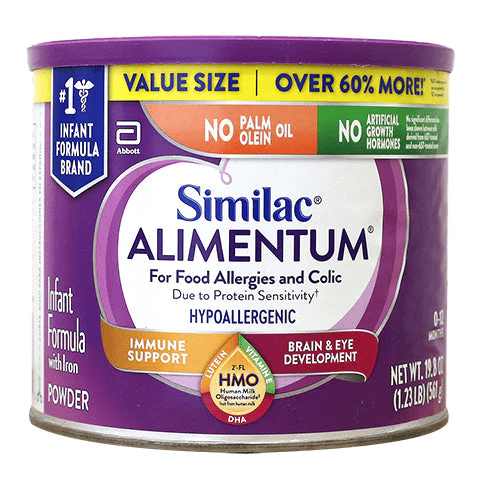
A gentle, hypoallergenic formula that skips both milk and corn
Why families choose it:
Like Nutramigen, Alimentum is hypoallergenic, using broken-down casein instead of whole milk proteins. But what makes the ready-to-feed (RTF) version stand out is that it’s corn-free, a relief for families who suspect multiple sensitivities.
What’s inside:
- Extensively hydrolyzed casein
- DHA, ARA, and key nutrients
- No lactose and no corn (RTF version only)
What parents notice:
Many babies respond quickly—especially if fussiness was paired with spit-up, bloating, or eczema. The ready-to-feed format is often tolerated better than powder, possibly due to fewer additives.
Why it helps:
Removing both milk proteins and lactose can reduce gut fermentation and inflammation. Fewer irritants mean a calmer digestive system—and sometimes, a calmer baby.
Gerber Good Start SoothePro

A probiotic-powered formula for day-to-day fussiness
Why families start here:
If your baby is fussy but doesn’t show signs of allergy or severe GI distress, SoothePro is a gentle option. It contains L. reuteri, a probiotic that’s been shown to reduce crying time in colicky babies. It also includes partially hydrolyzed whey and reduced lactose—helpful for tiny tummies still figuring things out.
What’s inside:
- Partially hydrolyzed whey protein
- L. reuteri probiotic
- DHA, 2’-FL HMO, and gentle carbs
What parents notice:
Babies tend to cry less, poop more regularly, and seem more settled during feeds. The probiotic gives a gut health boost without needing separate drops.
Why it helps:
L. reuteri may reduce colic-related crying by up to 50%, especially when paired with easily digestible proteins and lower lactose content.
Final Thoughts: Colic Is Real—and You Deserve Support
Colic can leave you feeling helpless, frustrated, and heartbroken. It’s okay if you’ve cried right alongside your baby. It’s okay if you’re trying formula changes because you just want to help them feel better.
These formulas aren’t magic. But for some babies, they make a big difference. Whether your baby needs a hypoallergenic switch or just more digestive support, these options give you a place to start—and permission to try.
Watch your baby. Follow their cues. And know that whatever you choose, the goal isn’t perfection. It’s comfort. For both of you.
Citations
- Lucassen, P. et al. (1998). Effectiveness of treatments for infantile colic. BMJ, 316, 1563–1568. https://doi.org/10.1136/bmj.316.7144.1563
- Savino, F. et al. (2006). Reduction of crying episodes owing to infantile colic. Eur J Clin Nutr, 60, 1304–1310. https://doi.org/10.1038/sj.ejcn.1602457
- Szajewska, H. & Dryl, R. (2021). Probiotics for the management of infantile colic. MCN, 46(2), E3. https://doi.org/10.1097/NMC.0000000000000706
- Fatheree, N. et al. (2016). Hypoallergenic formula with LGG for babies with colic. WJGP, 7(1), 160–170. https://doi.org/10.4291/wjgp.v7.i1.160
- Haiden, N. et al. (2024). Infant formulas for functional GI disorders: ESPGHAN position paper. JPGN. https://doi.org/10.1002/jpn3.12240
- Turco, R. et al. (2020). Efficacy of a partially hydrolyzed formula with L. reuteri for colic. Clinical Nutrition. https://doi.org/10.1016/j.clnu.2020.05.048